HCMONTHLY CASE LAW ARCHIVE

Madhya Pradesh High Court Judgments in July 2026: Case Law Digest

Read 890 LawLens analyses of Madhya Pradesh High Court judgments published in July 2026, covering key rulings, legal principles and case law.

← BACK TO MADHYA PRADESH COURT REPORT

PERMANENT MONTHLY EDITIONS

Browse by month

AUTOMATICALLY UPDATED

July 2026 Judgments

890 ARTICLES · NEWEST FIRST
Land rights cannot be granted over notified water bodies despite long-term possession, rules Madhya Pradesh High Court while upholding the removal of encroachments on Khandwa’s Shakkar Talab.. Zubaida vs The Municipal Corporation Khandwa. Madhya Pradesh High Court. LawLens

Madhya Pradesh High Court·

Environmental LawProperty and Real Estate Law

Land rights cannot be granted over notified water bodies despite long-term possession, rules Madhya Pradesh High Court while upholding the removal of encroachments on Khandwa’s Shakkar Talab.

The petitioners, residents of Shakkar Talab Ward, Khandwa, challenged a Notice-cum-Order dated February 19, 2025, issued under Section 322 of the M.P. Municipal Corporation Act, 1956, which directed the removal of the...

2 MIN READ

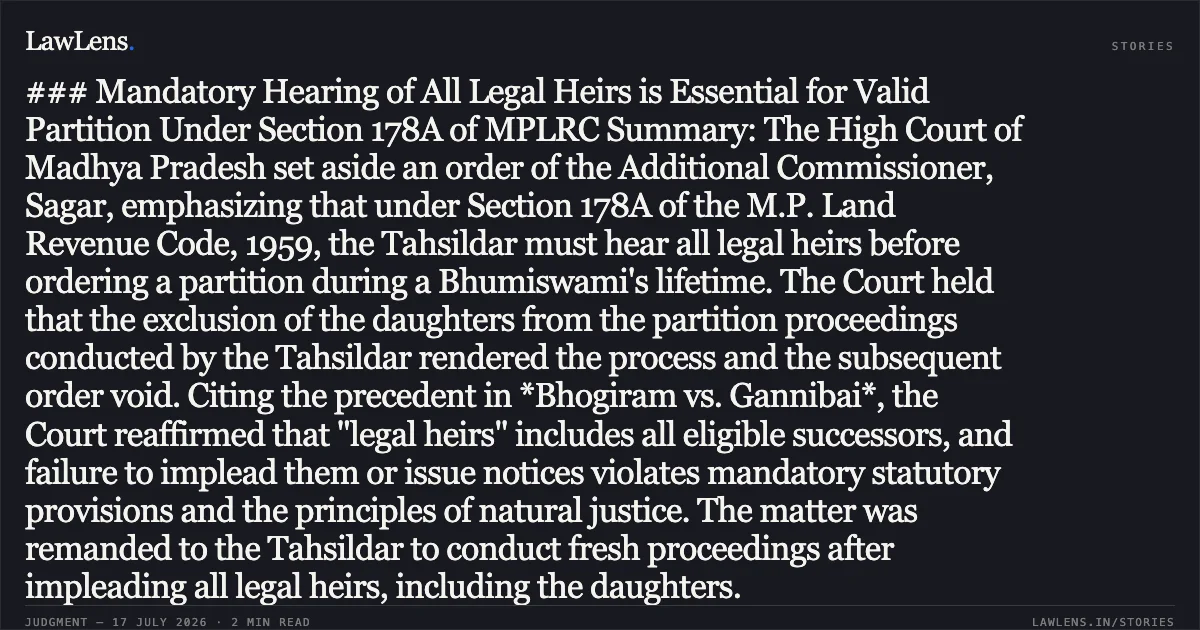
### Mandatory Hearing of All Legal Heirs is Essential for Valid Partition Under Section 178A of MPLRC Summary: The High Court of Madhya Pradesh set aside an order of the Additional Commissioner, Sagar, emphasizing that under Section 178A of the M.P. Land Revenue Code, 1959, the Tahsildar must hear all legal heirs before ordering a partition during a Bhumiswami's lifetime. The Court held that the exclusion of the daughters from the partition proceedings conducted by the Tahsildar rendered the process and the subsequent order void. Citing the precedent in *Bhogiram vs. Gannibai*, the Court reaffirmed that "legal heirs" includes all eligible successors, and failure to implead them or issue notices violates mandatory statutory provisions and the principles of natural justice. The matter was remanded to the Tahsildar to conduct fresh proceedings after impleading all legal heirs, including the daughters.. Smt. Amrita Singh vs Smt. Anita Singh Chouhan. Madhya Pradesh High Court. LawLens

Madhya Pradesh High Court·

Property and Real Estate LawCivil Procedure and Evidence

### Mandatory Hearing of All Legal Heirs is Essential for Valid Partition Under Section 178A of MPLRC Summary: The High Court of Madhya Pradesh set aside an order of the Additional Commissioner, Sagar, emphasizing that under Section 178A of the M.P. Land Revenue Code, 1959, the Tahsildar must hear all legal heirs before ordering a partition during a Bhumiswami's lifetime. The Court held that the exclusion of the daughters from the partition proceedings conducted by the Tahsildar rendered the process and the subsequent order void. Citing the precedent in *Bhogiram vs. Gannibai*, the Court reaffirmed that "legal heirs" includes all eligible successors, and failure to implead them or issue notices violates mandatory statutory provisions and the principles of natural justice. The matter was remanded to the Tahsildar to conduct fresh proceedings after impleading all legal heirs, including the daughters.

The petitioners (daughters of late Bahadur Singh) challenged an order passed by the Additional Commissioner, Sagar, which set aside a previous order of the Sub-Divisional Officer (SDO).

2 MIN READ

### Delay Condoned and Writ Appeal Restored Subject to Voluntary Community Service Reporting Summary of the Judgment: The High Court of Madhya Pradesh condoned a 52-day delay and restored a Writ Appeal (W.A. No. 3425/2025) that had been dismissed for procedural defaults. Applying settled law, the Court ruled that litigants should not suffer for the lapses of their counsel. Notably, the Court introduced a "Social Audit" concept, directing the Officer-In-Charge and counsel to visit a school for the speech and hearing impaired as a form of community service. The restoration of the appeal is contingent upon the submission of a report detailing their visit and observations regarding the institution's welfare standards.. The State Of Madhya Pradesh vs Ram Prasad Chikwa. Madhya Pradesh High Court. LawLens

Madhya Pradesh High Court·

Civil Procedure and EvidenceAdministrative and Public Law

### Delay Condoned and Writ Appeal Restored Subject to Voluntary Community Service Reporting Summary of the Judgment: The High Court of Madhya Pradesh condoned a 52-day delay and restored a Writ Appeal (W.A. No. 3425/2025) that had been dismissed for procedural defaults. Applying settled law, the Court ruled that litigants should not suffer for the lapses of their counsel. Notably, the Court introduced a "Social Audit" concept, directing the Officer-In-Charge and counsel to visit a school for the speech and hearing impaired as a form of community service. The restoration of the appeal is contingent upon the submission of a report detailing their visit and observations regarding the institution's welfare standards.

The State of Madhya Pradesh filed a Writ Appeal (W.A. No.3425/2025) which was dismissed on February 27, 2026, for non-compliance with a common conditional order regarding the curing of defaults.

2 MIN READ

### Quasi-judicial Orders Must Be Speaking Orders with Cogent Reasons Supportings Conclusions Case Brief: Facts: The petitioner, an Assistant Manager, challenged a disciplinary order (28.12.2023) withholding annual increments and a subsequent appellate order (27.10.2025) rejecting his appeal. The petitioner contended that both orders were non-speaking, unreasoned, and failed to consider the merits of his explanation and grounds for appeal. Issue: Whether a disciplinary or appellate authority, while exercising quasi-judicial powers, is legally obligated to pass a reasoned and speaking order. Court's Reasoning: 1. Quasi-Judicial Obligations: The Court observed that authorities exercising quasi-judicial powers must apply their minds to the facts and record justifiable reasons. An order affecting the rights of a party must "speak" for itself. 2. Natural Justice and Transparency: Referring to *Kranti Associates Pvt. Ltd. v. Masood Ahmed Khan*, the Court emphasized that recording reasons is a component of natural justice and "the soul of justice." It acts as a restraint on arbitrary exercise of power and facilitates judicial review. 3. Administrative Accountability: Citing *State of Punjab v. Bandip Singh*, the Court held that executive decisions must be composite and self-sustaining, containing all reasons that led to the conclusion. "Rubber-stamp" or "pretence" reasons do not satisfy the requirement of a valid decision-making process. Conclusion: Finding both the impugned punishment order and the appellate order to be non-speaking and devoid of reasoning, the High Court quashed both orders. The matter was remanded to the Disciplinary Authority to pass a fresh, reasoned order after providing the petitioner an opportunity for a personal hearing. Judgment: Petition allowed; orders quashed and remanded for fresh consideration.. Piyush Atulker vs Madhya Pradesh Madhya Kshetra Vidyut Vitran Co. Ltd.. Madhya Pradesh High Court. LawLens

Madhya Pradesh High Court·

Employment and Labour LawAdministrative and Public Law

### Quasi-judicial Orders Must Be Speaking Orders with Cogent Reasons Supportings Conclusions Case Brief: Facts: The petitioner, an Assistant Manager, challenged a disciplinary order (28.12.2023) withholding annual increments and a subsequent appellate order (27.10.2025) rejecting his appeal. The petitioner contended that both orders were non-speaking, unreasoned, and failed to consider the merits of his explanation and grounds for appeal. Issue: Whether a disciplinary or appellate authority, while exercising quasi-judicial powers, is legally obligated to pass a reasoned and speaking order. Court's Reasoning: 1. Quasi-Judicial Obligations: The Court observed that authorities exercising quasi-judicial powers must apply their minds to the facts and record justifiable reasons. An order affecting the rights of a party must "speak" for itself. 2. Natural Justice and Transparency: Referring to *Kranti Associates Pvt. Ltd. v. Masood Ahmed Khan*, the Court emphasized that recording reasons is a component of natural justice and "the soul of justice." It acts as a restraint on arbitrary exercise of power and facilitates judicial review. 3. Administrative Accountability: Citing *State of Punjab v. Bandip Singh*, the Court held that executive decisions must be composite and self-sustaining, containing all reasons that led to the conclusion. "Rubber-stamp" or "pretence" reasons do not satisfy the requirement of a valid decision-making process. Conclusion: Finding both the impugned punishment order and the appellate order to be non-speaking and devoid of reasoning, the High Court quashed both orders. The matter was remanded to the Disciplinary Authority to pass a fresh, reasoned order after providing the petitioner an opportunity for a personal hearing. Judgment: Petition allowed; orders quashed and remanded for fresh consideration.

The petitioner, an Assistant Manager, challenged two orders: a disciplinary order dated 28.12.2023 [Annexure P-2] and an appellate order dated 27.10.2025 [Annexure P-1].

2 MIN READ

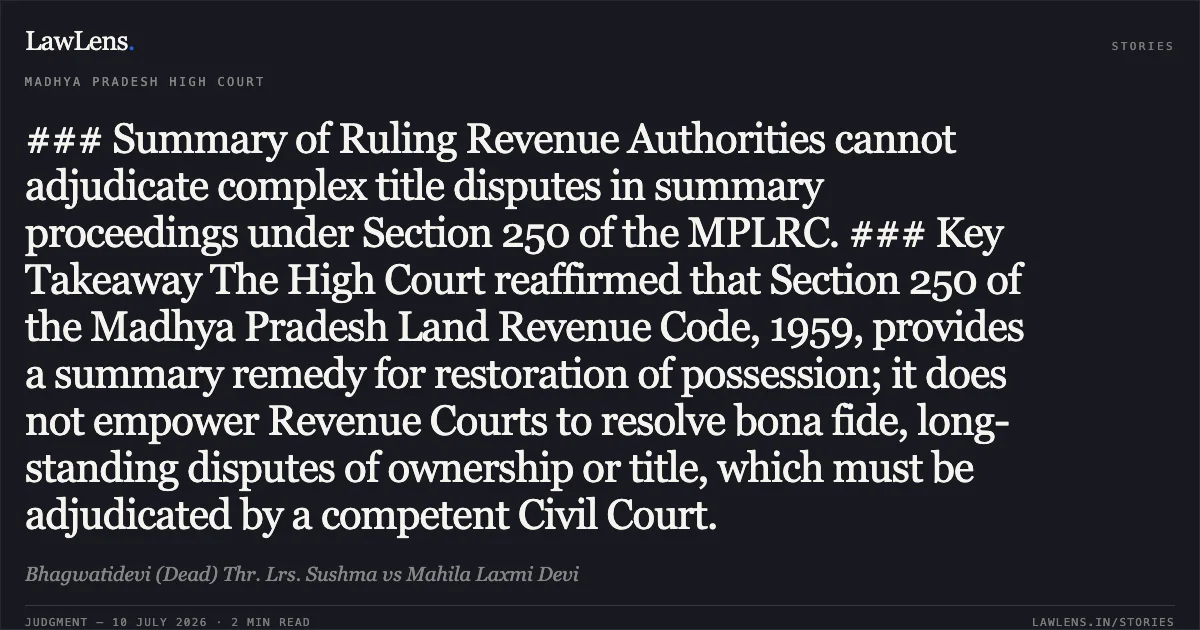
### Summary of Ruling Revenue Authorities cannot adjudicate complex title disputes in summary proceedings under Section 250 of the MPLRC. ### Key Takeaway The High Court reaffirmed that Section 250 of the Madhya Pradesh Land Revenue Code, 1959, provides a summary remedy for restoration of possession; it does not empower Revenue Courts to resolve bona fide, long-standing disputes of ownership or title, which must be adjudicated by a competent Civil Court.. Bhagwatidevi (Dead) Thr. Lrs. Sushma vs Mahila Laxmi Devi. Madhya Pradesh High Court. LawLens

Madhya Pradesh High Court·

Property and Real Estate LawAdministrative and Public Law

### Summary of Ruling Revenue Authorities cannot adjudicate complex title disputes in summary proceedings under Section 250 of the MPLRC. ### Key Takeaway The High Court reaffirmed that Section 250 of the Madhya Pradesh Land Revenue Code, 1959, provides a summary remedy for restoration of possession; it does not empower Revenue Courts to resolve bona fide, long-standing disputes of ownership or title, which must be adjudicated by a competent Civil Court.

The petitioners are legal heirs of late Smt. Bhagwati Devi, who claimed ownership of a residential property in Shivpuri through registered sale deeds from 1940 and 1950

2 MIN READ

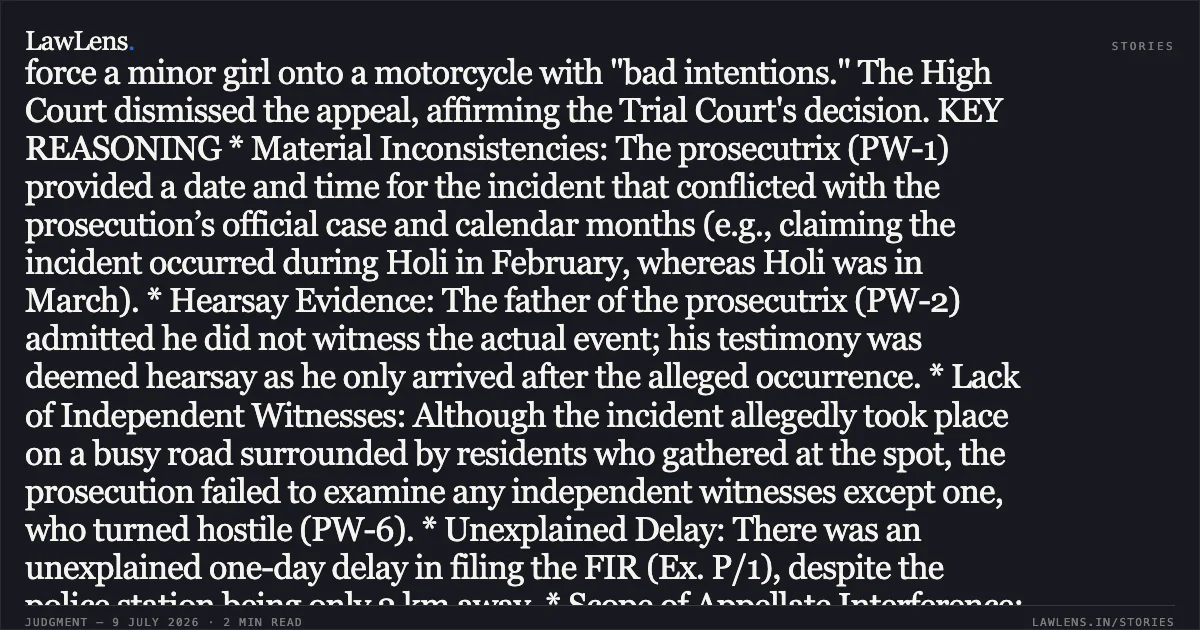
### Judgment Summary: Criminal Appeal No. 1199 of 2021 LEGAL HEADLINE Acquittal upheld where prosecutrix’s testimony lacks independent corroboration and contains material inconsistencies regarding the incident. OVERVIEW The State of Madhya Pradesh appealed against the acquittal of Rajesh Mishra and Babulal Thakur, who were charged under Section 354 of the IPC and Sections 7/8 of the POCSO Act. The prosecution alleged that the accused attempted to force a minor girl onto a motorcycle with "bad intentions." The High Court dismissed the appeal, affirming the Trial Court's decision. KEY REASONING * Material Inconsistencies: The prosecutrix (PW-1) provided a date and time for the incident that conflicted with the prosecution’s official case and calendar months (e.g., claiming the incident occurred during Holi in February, whereas Holi was in March). * Hearsay Evidence: The father of the prosecutrix (PW-2) admitted he did not witness the actual event; his testimony was deemed hearsay as he only arrived after the alleged occurrence. * Lack of Independent Witnesses: Although the incident allegedly took place on a busy road surrounded by residents who gathered at the spot, the prosecution failed to examine any independent witnesses except one, who turned hostile (PW-6). * Unexplained Delay: There was an unexplained one-day delay in filing the FIR (Ex. P/1), despite the police station being only 2 km away. * Scope of Appellate Interference: Following the principles in *H.D. Sundara v. State of Karnataka (2023)*, the Court held that if the Trial Court’s view is a "possible view," the appellate court cannot overturn an acquittal simply because another view might exist. CONCLUSION The High Court found no perversity or manifest error in the Trial Court’s findings. Since the prosecution failed to prove the charges beyond a reasonable doubt, the acquittal was affirmed.. The State Of Madhya Pradesh vs Rajesh Mishra. Madhya Pradesh High Court. LawLens

Madhya Pradesh High Court·

Criminal LawCriminal Procedure and Evidence

### Judgment Summary: Criminal Appeal No. 1199 of 2021 LEGAL HEADLINE Acquittal upheld where prosecutrix’s testimony lacks independent corroboration and contains material inconsistencies regarding the incident. OVERVIEW The State of Madhya Pradesh appealed against the acquittal of Rajesh Mishra and Babulal Thakur, who were charged under Section 354 of the IPC and Sections 7/8 of the POCSO Act. The prosecution alleged that the accused attempted to force a minor girl onto a motorcycle with "bad intentions." The High Court dismissed the appeal, affirming the Trial Court's decision. KEY REASONING * Material Inconsistencies: The prosecutrix (PW-1) provided a date and time for the incident that conflicted with the prosecution’s official case and calendar months (e.g., claiming the incident occurred during Holi in February, whereas Holi was in March). * Hearsay Evidence: The father of the prosecutrix (PW-2) admitted he did not witness the actual event; his testimony was deemed hearsay as he only arrived after the alleged occurrence. * Lack of Independent Witnesses: Although the incident allegedly took place on a busy road surrounded by residents who gathered at the spot, the prosecution failed to examine any independent witnesses except one, who turned hostile (PW-6). * Unexplained Delay: There was an unexplained one-day delay in filing the FIR (Ex. P/1), despite the police station being only 2 km away. * Scope of Appellate Interference: Following the principles in *H.D. Sundara v. State of Karnataka (2023)*, the Court held that if the Trial Court’s view is a "possible view," the appellate court cannot overturn an acquittal simply because another view might exist. CONCLUSION The High Court found no perversity or manifest error in the Trial Court’s findings. Since the prosecution failed to prove the charges beyond a reasonable doubt, the acquittal was affirmed.

On February 9, 2018, the 15-year-old prosecutrix alleged that while she was moving idols into her house, the accused (Rajesh and Babulal) arrived on a motorcycle and caught hold of her hand with "bad intentions".

2 MIN READ

### Acquittal Sustained Due to Violation of Section 50 NDPS Act and Reliance on Stock Witnesses Core Legal Principle: Strict compliance with Section 50 NDPS Act is mandatory, and reliance on habitual "stock witnesses" vitiates the prosecution's case. Case Summary: The High Court of Madhya Pradesh dismissed the State’s appeal against the acquittal of an accused charged under Section 20(B)(ii)(B) of the NDPS Act. The Court identified several fatal flaws in the prosecution's case: * Failure of Independent Witnesses: The primary independent witnesses turned hostile, admitting they signed blank papers under police pressure. One witness was identified as a "stock witness" frequently used by the police in multiple cases. * Section 50 Non-Compliance: Although the contraband was allegedly in a sack, a personal search was also conducted. The Court ruled that providing the illiterate accused with "three options" for search, without clearly informing him of his legal right to be searched before a Magistrate or Gazetted Officer, constituted a violation of Section 50 of the NDPS Act. * Procedural Lapses: The prosecution failed to prove the FSL report during the trial or put it to the accused during his Section 313 CrPC examination. Additionally, inconsistencies regarding the weighing process and the investigation's continuity further weakened the case. Conclusion: In line with established precedents (including *Mallappa v. State of Karnataka*), the Court held that the trial court's view was plausible and not perverse. Since the appellate court should not interfere with an acquittal unless the findings are wholly unreasonable, the acquittal was upheld.. The State Of Madhya Pradesh vs Ashok Gupta @ Banta. Madhya Pradesh High Court. LawLens

Madhya Pradesh High Court·

Criminal LawCriminal Procedure and Evidence

### Acquittal Sustained Due to Violation of Section 50 NDPS Act and Reliance on Stock Witnesses Core Legal Principle: Strict compliance with Section 50 NDPS Act is mandatory, and reliance on habitual "stock witnesses" vitiates the prosecution's case. Case Summary: The High Court of Madhya Pradesh dismissed the State’s appeal against the acquittal of an accused charged under Section 20(B)(ii)(B) of the NDPS Act. The Court identified several fatal flaws in the prosecution's case: * Failure of Independent Witnesses: The primary independent witnesses turned hostile, admitting they signed blank papers under police pressure. One witness was identified as a "stock witness" frequently used by the police in multiple cases. * Section 50 Non-Compliance: Although the contraband was allegedly in a sack, a personal search was also conducted. The Court ruled that providing the illiterate accused with "three options" for search, without clearly informing him of his legal right to be searched before a Magistrate or Gazetted Officer, constituted a violation of Section 50 of the NDPS Act. * Procedural Lapses: The prosecution failed to prove the FSL report during the trial or put it to the accused during his Section 313 CrPC examination. Additionally, inconsistencies regarding the weighing process and the investigation's continuity further weakened the case. Conclusion: In line with established precedents (including *Mallappa v. State of Karnataka*), the Court held that the trial court's view was plausible and not perverse. Since the appellate court should not interfere with an acquittal unless the findings are wholly unreasonable, the acquittal was upheld.

The State appealed a trial court judgment dated February 24, 2022, which acquitted the respondent of charges under the Narcotic Drugs and Psychotropic Substances (NDPS) Act.

2 MIN READ